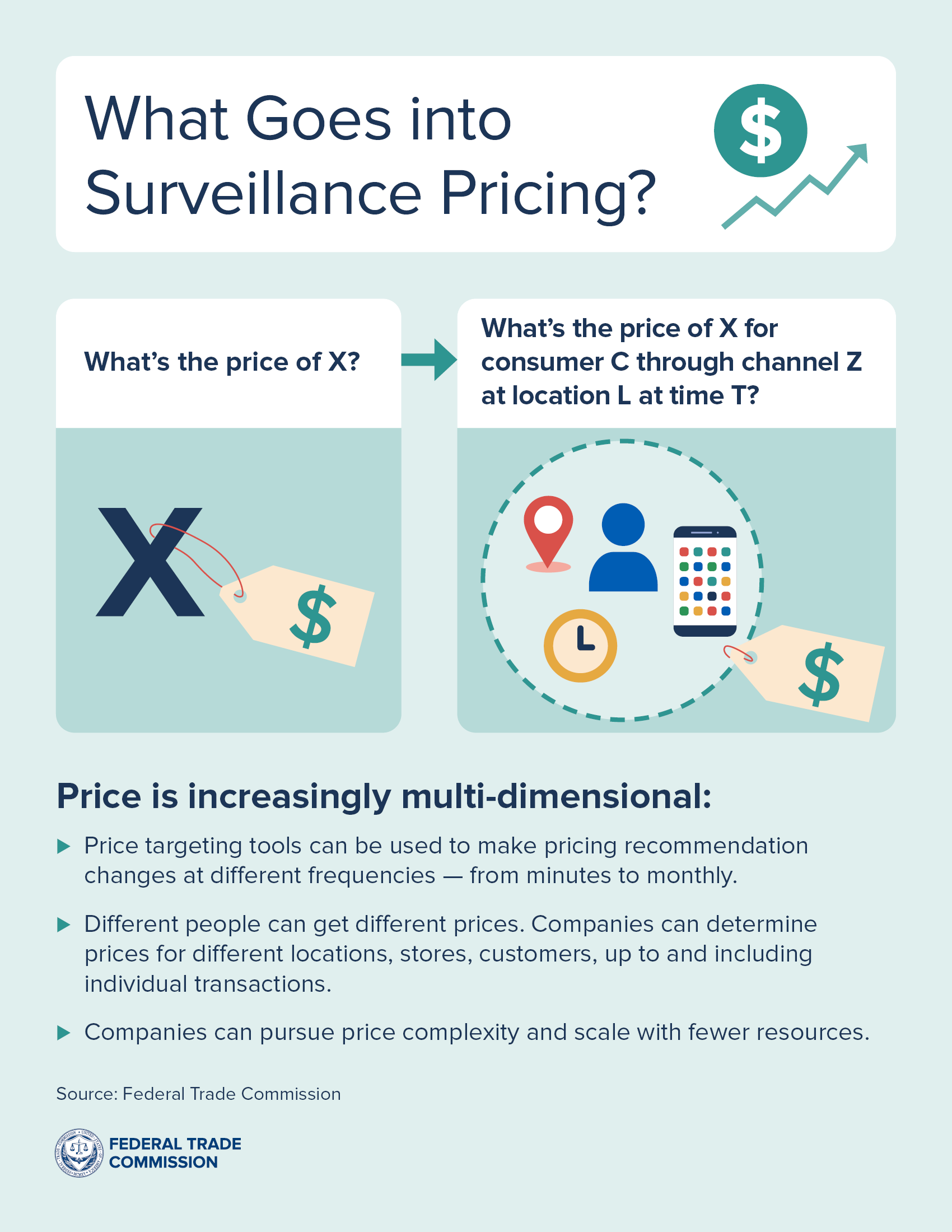
The Federal Trade Commission’s initial findings from its surveillance pricing market study revealed that details like a person’s precise location or browser history can be frequently used to target individual consumers with different prices for the same goods and services.
The staff perspective is based on an examination of documents obtained by FTC staff’s 6(b) orders sent to several companies in July aiming to better understand the shadowy market that third-party intermediaries use to set individualized prices for products and services based on consumers’ characteristics and behaviors, like location, demographics, browsing patterns and shopping history.
Staff found that consumer behaviors ranging from mouse movements on a webpage to the type of products that consumers leave unpurchased in an online shopping cart can be tracked and used by retailers to tailor consumer pricing.
“Initial staff findings show that retailers frequently use people’s personal information to set targeted, tailored prices for goods and services—from a person’s location and demographics, down to their mouse movements on a webpage,” said FTC Chair Lina M. Khan. “The FTC should continue to investigate surveillance pricing practices because Americans deserve to know how their private data is being used to set the prices they pay and whether firms are charging different people different prices for the same good or service.”
The FTC’s study of the 6(b) documents is still ongoing. The staff perspective is based on an initial analysis of documents provided by Mastercard, Accenture, PROS, Bloomreach, Revionics and McKinsey & Co.
The FTC’s 6(b) study focuses on intermediary firms, which are the middlemen hired by retailers that can algorithmically tweak and target their prices. Instead of a price or promotion being a static feature of a product, the same product could have a different price or promotion based on a variety of inputs—including consumer-related data and their behaviors and preferences, the location, time, and channels by which a consumer buys the product, according to the perspective.
The agency will only release information obtained from a 6(b) study as long as all data has been aggregated or anonymized to protect confidential trade secrets from company respondents, and therefore the staff perspective only includes hypothetical examples of surveillance pricing.
The staff perspective found that some 6(b) respondents can determine individualized and different pricing and discounts based on granular consumer data, like a cosmetics company targeting promotions to specific skin types and skin tones. The perspective also found that the intermediaries the FTC examined can show higher priced products based on consumers’ search and purchase activity. As one hypothetical outlined, a consumer who is profiled as a new parent may intentionally be shown higher priced baby thermometers on the first page of their search results.
The FTC staff found that the intermediaries worked with at least 250 clients that sell goods or services ranging from grocery stores to apparel retailers. The FTC found that widespread adoption of this practice may fundamentally upend how consumers buy products and how companies compete.
As the FTC continues its work in this area, it is issuing a request for information today seeking public comment on consumers’ experiences with surveillance pricing. The RFI also asks for comments from businesses about whether surveillance pricing tools can lead to competitors gaining an unfair advantage, and whether gig workers or employees have been impacted by the use of surveillance pricing to determine their compensation. Comments are due by April 17.
The Commission voted 3-2 to allow staff to issue the report. Commissioners Andrew Ferguson and Melissa Holyoak issued a dissenting statement related to the release of the initial research summaries.
The FTC has additional resources on the interim findings, including a blog post advocating for further engagement with this issue, an issue spotlight with more background and research on surveillance pricing and research summaries based on the staff review and initial insights of 6(b) study documents.
6 charged in Massachusetts immigration marriage fraud scheme AP News Source link
TikTok’s Top 10 Songs of Summer 2026 Show That Old Music Is Winning Again RouteNote Source…
Anonymous Instagram Account Reveals Stories of Abuse in Montreal's Restaurants and Bars Time Out Worldwide Source…
NEW IMAGES: We're getting our first look at the suspected ringleader of an alleged marriage…
Feds dismantle $6M marriage fraud ring tied to immigration scam in Mass Yahoo Source link
RIMAN Highlights Product and Ingredient Innovation at RIMAN North America Convention 2026 PR Newswire UK Source…