



Scams are no longer just a security issue. They’re also a psychological one.
Social manipulation now drives the majority of fraud losses globally. In 2024, Europe saw a 156% increase in cases, while the U.S. recorded its highest-ever annual fraud losses. Today, scams account for more than 70% of total fraud losses globally.
The common thread? These scams don’t bypass security systems; they bypass people. In cases like authorized push payment (APP) scams, it’s the banking customer who initiates the payment, authorizes it, and often insists on completing it. The fraud works not because the system fails, but because the person is convinced they’re doing the right thing.
Banks have invested heavily in customer education. That’s important, but it has limits.
That’s because scams don’t just misinform. They override judgment. In the middle of a scam, fear, urgency, and trust are all being manipulated. Few people will recall a static awareness campaign under that kind of pressure.
KPMG’s Global Banking Scam Survey reflected this frustration. Many fraud professionals are skeptical about whether traditional awareness campaigns actually help when it matters. The conclusion is clear: the missing piece is timing.
If education comes too early, it’s forgotten. If it comes too late, the damage is done. The critical moment is during the scam attempt—when the individual is unsure, hesitating, or looking for validation.Intervention needs to happen while the scam is still unfolding. Not with a delay, and not from a disconnected channel, but from within the banking environment itself, right as the customer is hesitating, second-guessing, or uncertain.
That’s the point of maximum impact. And in most fraud stacks, it’s still a blind spot.
At ThreatMark, we’ve been exploring how to bring real-time decision support closer to the customer. One outcome of that work is ScamFlag, a tool embedded inside the digital banking app that helps users assess suspicious messages in real-time.
When something feels off, users can upload a screenshot, whether it’s an SMS, WhatsApp message, email, or web link. ScamFlag uses fraud-trained AI to assess content instantly, detecting signs of phishing, impersonation, urgency manipulation, or fake payment instructions.
The result is a straightforward verdict, with a plain-language explanation of why.
This doesn’t just protect. It informs, in context. It transforms a high-risk moment into a learning opportunity.
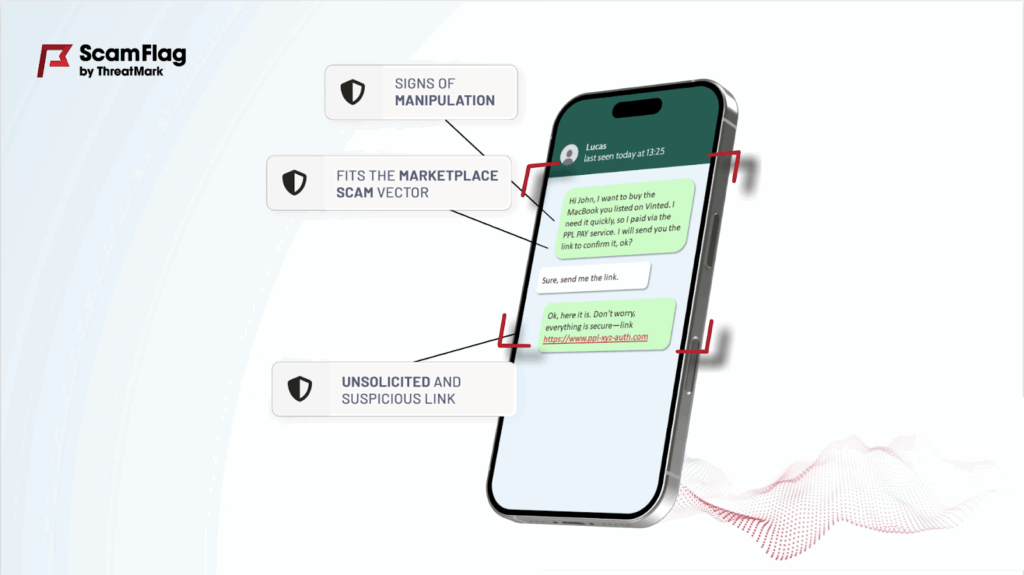
This intervention doesn’t just benefit the user. For banks, it addresses several blind spots in today’s fraud operations:
- Underreported scams: ScamFlag surfaces threats that never result in a claim but still indicate risk
- Workload reduction: It allows users to self-assess and avoid unnecessary contact center interactions
- Scam intelligence: It feeds frontline insights into how fraudsters are adapting their tactics
- Reimbursement clarity: Each event is timestamped and logged, supporting fair and fast decisions
- Improved customer trust and fewer escalations
There’s a behavioral component worth noting. Research into automation bias shows that users sometimes respond more seriously to a warning from a trusted system than they would to a person, even a bank employee. The reason is simple: it feels neutral.
Behavioral detection will always be a cornerstone of scam prevention. But once a customer is convinced, it’s not always enough. Helping them recognize manipulation in the moment—and giving them a reason to stop—requires a different approach.
ScamFlag doesn’t replace education or detection. It fills the gap between the two.
For banks, that means fewer losses, better visibility, and greater trust. For customers, it means one more chance to avoid becoming a victim.
Learn how ScamFlag supports smarter scam prevention at https://www.threatmark.com/scamflag/
Source link