



Intent is one of the keys to a fraud case. False statements alone are not enough. Prosecutors must show the defendant knew the statements were false and made them to gain an advantage. In the Letitia James mortgage fraud case, the documents seem to be clear evidence of a fraud. But how can the prosecutor prove her intent?
Intent can be proven through the documents, the sequence, the pattern, and the benefits that followed.
The Core Question
Did Letitia James knowingly make false statements to secure financial benefits, and did her actions show an intent to deceive?
The Documentary Proof
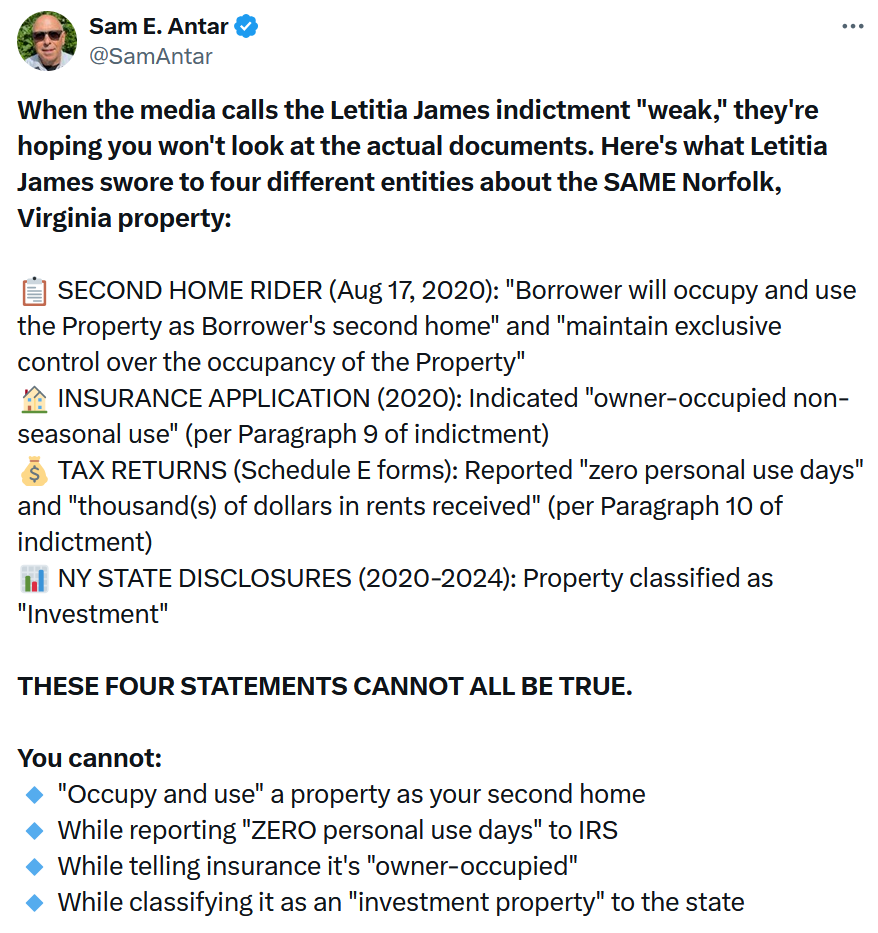
Forensic accountant Sam Antar uncovered the documents that he says prove the fraud related to the Norfolk, VA property at 3121 Peronne Avenue:
How Prosecutors Prove State of Mind
Of course, we can’t get inside someone’s mind to prove intent. That’s why judges and juries have to infer intent from the conduct of people and the circumstances. As a forensic accountant, how can I find proof of someone’s state of mind to show the judge or jury their intent to defraud?
Usually, intent isn’t shown through a single act. It is proven through a pattern of behavior. If a person makes a mistake on one form, we might believe that it was accidental. But when the same kind of misstatement happens repeatedly across years, lenders, and jurisdictions, the “mistake” starts to look deliberate.
Patterns “tell on” people. They reveal a state of mind. A person who misclassifies a property once could be confused or careless. A person who does it ten times across twenty years, and always in ways that have financial advantages, has created a pattern that points directly to intent. As investigators we can look for:
- Repetition – If you do something multiple times, it shows conscious acts and knowledge.
- Timing – When you do something can become as important as the fact that you did it.
- Benefit – Receiving benefits from the act(s) can help show motive.
- Cover-up – When people hide documents, alter records, or otherwise try to hide the truth, it can be powerful evidence.
These items are the building blocks when we’re proving intent. Here’s an interesting video from Nate The Lawyer about the issue of intent in the James case.
Courts allow intent to be inferred from conduct. Here are some points that could be analyzed relative to the Tish James case to see if there is any evidence that could point to her intent to commit mortgage fraud:
- Contradictory statements on multiple occasions – This is actually the core of the case against James.
- A repeating pattern that creates a benefit – One instance could be an error or negligence. Repetition across years, lenders, and agencies looks deliberate, especially when the misstatement consistently produces a financial advantage. (See this article by Sam Antar, showing long-running inconsistencies on multiple properties as it relates to property use and unit counts. The false statements led to better loan terms, lower insurance rates, or tax advantages.)
- Different stories to different gatekeepers, depending on the financial advantage – Banks, insurers, the IRS, and state disclosure authorities each received a version that served a purpose. (See the different stories here.)
- Lack of contemporaneous correction – If true errors were made in the process of getting the mortgage or insurance, filing the taxes, or making disclosures to the state, you might expect to see corrections done in real time. To claim “error” only after the discrepancies were uncovered and made public years later, suggests they weren’t really errors.
- Destroying or changing evidence – When someone starts deleting, destroying, altering, or omitting evidence after the come under scrutiny, this may also signal intent. Again, innocent mistakes are usually corrected quickly and transparently. Delay, selective disclosure, or unusual alterations can be nefarious.
- Knowledge and experience – Look at a person’s knowledge, education, and experience to determine what they should be aware of. A sophisticated public official who has seen and signed many real estate and disclosure documents knows what occupancy and unit classifications mean. Experience narrows the space for “I did not understand.”
- Witnesses – Testimony from those involved can help establish intent. They may have important information that shows the false statements were not accidental.
- Quantifying the motive – In this case, someone doesn’t necessarily need to have a financial benefit in order for a crime to have occurred. However, if there is a financial benefit, such as a lower interest rate, lower insurance premiums, tax deduction, or eligibility for programs, then this could help show motive and intent.
This is not an all-inclusive list. There are lots of ways to prove intent circumstantially, but these are some of the most common ways, and many of these are easily applied to the Letitia James case.
Under count two of the James indictment, False Statement to a Financial Institution (18 U.S.C. § 1014), the government must only prove that she knowingly made a false statement with the intent to influence. It doesn’t require that a bank relied on the false statement or lost money. The documents make contradictory statements about James’s residency and occupancy. Other documents repeat advantageous classifications across institutions and years. The financial outcomes (i.e. benefits to James) align with the misstatements.
Why This Matters
Intent separates a mistake from a crime. When the state’s top law enforcement officer is involved, equal treatment is the standard. The question is not whether the paperwork conflicts. It does. The question is whether the conflicts, timing, pattern, and benefits show she intended to deceive. The record strongly points to “yes.”
Credit to Sam Antar
Specific public documents and timelines cited here were first compiled and published by Sam Antar, whose research drew on land records, recorded loan files, insurance applications, tax filings, and state disclosures. His work retrieving and analyzing the documents, and then blogging about it extensively, made my analysis possible.
Source link